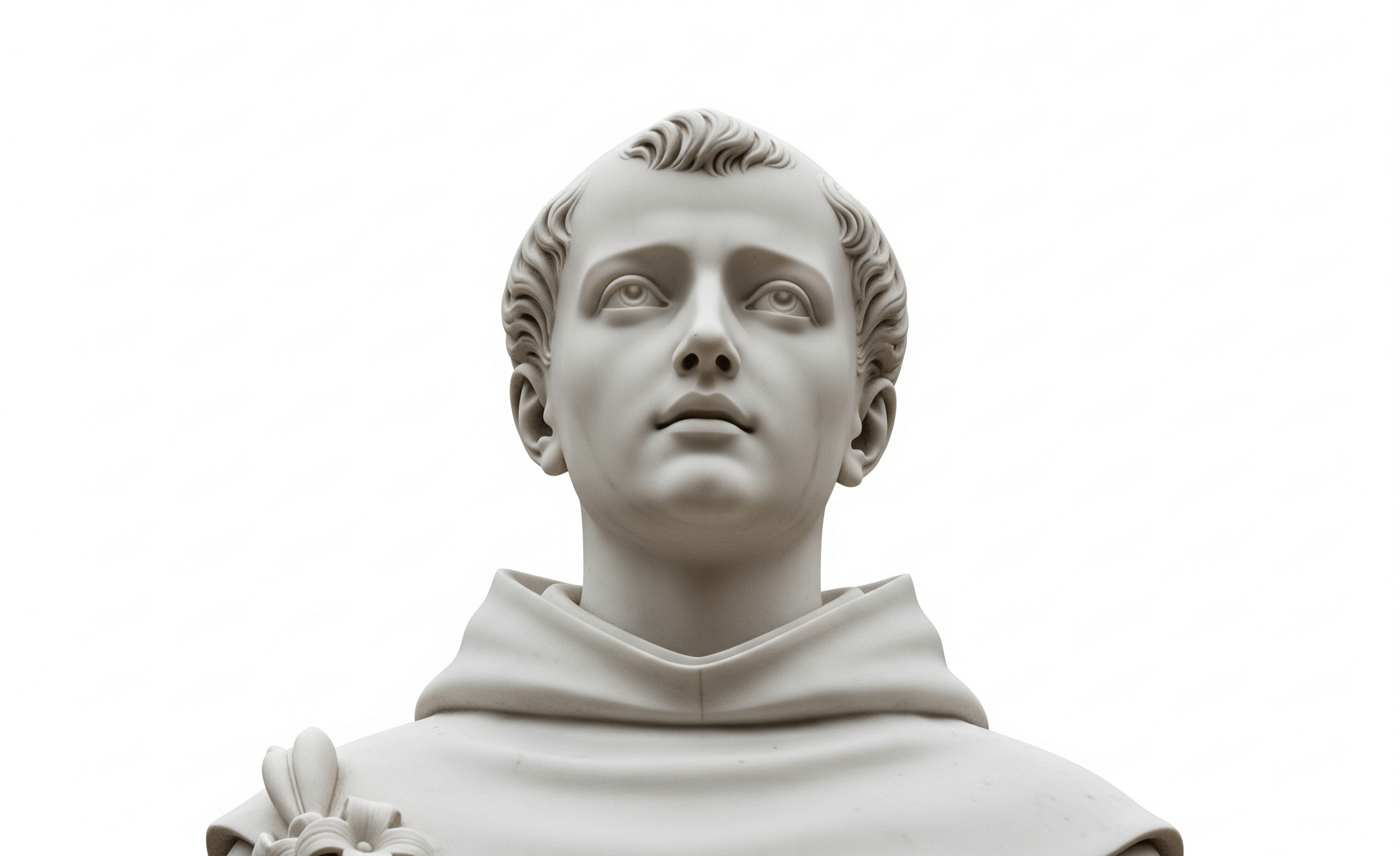
Our Patron
Saint Anthony of Padua
Use these links to navigate the chapters of the life of Saint Anthony, from his early years to his death and canonization.
Introduction:
Our Patron, Our Friend: The Wonder-Worker of the World
For Catholics around the globe, and especially for us in this parish, there are few saints who feel as close, as reliable, or as tenderly concerned with our daily lives as Saint Anthony of Padua. He is, quite simply, one of the most beloved and popular saints in the entire Catholic Church, venerated from his native Lisbon to his adopted Padua, and in every corner of the world. He is our patron, but more than that, he is a friend to all, a heavenly helper who listens with a compassionate heart to our every need, from the most profound spiritual crisis to the most common domestic frustration.
When we picture him, our minds almost invariably conjure one of two familiar images, both of which reveal the core of his beautiful soul. We may see him holding a spray of lilies, a timeless symbol of his purity of heart and life. But most often, and most tenderly, we see him with the Infant Jesus in his arms. This is not merely an artist's pious invention. It commemorates a grace of profound and intimate love, a miraculous apparition in which the Lord Jesus appeared to His devoted servant in the form of a child. As one tradition tells it, a friend who had offered Anthony lodging for the night grew curious, and peering into his room, was astonished to see it filled with a heavenly light. There he beheld Anthony cradling and conversing with the Christ Child, in a moment of pure, enraptured love.
This image of tender, personal encounter with the divine Lord is the perfect introduction to Saint Anthony, for it is this spirit of compassionate concern that defines his mission. His patronage extends to the very heart of our human vulnerabilities. He is famously the patron saint of lost things. But his care goes so much deeper. He is the patron of lost people and lost souls, the one we turn to when we or our loved ones have strayed from the path. He is a guide for those seeking a spouse, a comforter for the pregnant, a protector of the elderly, the sick, and the disabled. Most powerfully, he is a tireless defender of the poor, the hungry, and the oppressed.
In this, we see why he is so universally loved. His patronage covers the most common and acute forms of human anxiety: the desperation of poverty, the fear of losing something precious, the loneliness of seeking a partner, the sorrow of a lost soul. He is not a distant saint for a niche problem; he is the patron of our everyday, vulnerable humanity. He understands our anxieties, big and small, and this makes him a uniquely approachable and powerful friend in Heaven.
But to truly love our patron, we must know the man behind the miracles. His life was a breathtaking journey of transformation—from a wealthy nobleman to a humble, anonymous friar; from the most brilliant scholar in his country to a fiery preacher who could command the attention of even the fish in the sea. This is the story of Saint Anthony, the "Wonder-Worker," the "Ark of the Testament," and the "Evangelical Doctor".
Part I:
From Fernando to Anthony: A Heart on Fire for Christ
Long before the world knew him as Anthony of Padua, he was born Fernando Martins de Bulhões in 1195. He came from a wealthy and noble family in Lisbon, Portugal. His parents were devout, and from his earliest years, he was educated by the clergy of the Lisbon cathedral, who nurtured in him a deep love for God.
It soon became clear that Fernando’s heart was not set on the power or prestige that his family's status could offer. At the young age of fifteen, he made the decisive choice to renounce a future of worldly wealth and consecrate his life to God. He joined the Canons Regular of St. Augustine, a respected monastic order, at the Abbey of St. Vincent just outside Lisbon. After two years, however, he found that the frequent visits from his old friends and family from the city compromised the "fruitful tranquility" his soul craved for contemplation. He asked his superiors for a transfer, seeking greater seclusion for study and prayer.
He was sent to the Abbey of Santa Cruz in Coimbra, which was then the capital of Portugal and a renowned center of culture and learning. Here, for the next eight to ten years, the brilliant young canon immersed himself totally in the study of the Word of God. This was the foundational period of his life. With what his biographers describe as a "remarkable memory" , he dedicated himself to "prolonged reading, continued study and exact memorizing" of the Sacred Scriptures and the writings of the Church Fathers. His devotion was so singular that one biographer noted, "he entrusted to his tenacious memory whatever he read so that in short time he was able to acquire a knowledge of the Scriptures that no one else hoped to possess". He was ordained to the priesthood and became, by all accounts, one of the most learned men in Portugal, a living, breathing repository of sacred knowledge.
He might have lived and died as a celebrated Augustinian scholar, but God had a radically different plan. The decisive turning point, the event that would shatter his world and forge a saint, came in 1219. As guestmaster of the abbey, Fernando was in charge of hospitality. In this capacity, he met a small band of poor, joyful friars who had established a simple hermitage nearby. They were the followers of a new and radical movement led by a man named Francis of Assisi. These five friars were on their way to Morocco to preach the Gospel to the Muslims. Fernando was deeply and powerfully "attracted by their simple Gospel life style". Their poverty and joyful zeal stood in stark contrast to the learned and politicized world of his abbey.
Then, in February 1220, shocking news arrived. Those same five friars—Berard, Peter, Otho, Accursius, and Adjutus—had been captured, tortured, and ultimately beheaded in Morocco by the sultan for boldly refusing to renounce their faith in Jesus Christ. They were the first martyrs of the new Franciscan Order. Their holy relics were gathered, ransomed by the King of Portugal, and sent to be venerated in a great public procession. Their final resting place: Fernando's own abbey, the Church of the Holy Cross in Coimbra.
As this brilliant scholar, this man who had mastered the text of the Scriptures, stood and prayed before the physical remains of these five "heroic" men, his heart was "inflamed with the desire of martyrdom". A profound spiritual crisis seized him. He looked at his own life of learning and monastic comfort and, in comparison to their total sacrifice, he suddenly felt "embarrassed," considering it "mediocre and filled with compromise". In that moment, he understood the vast difference between knowing the Gospel and living it, between reading about Christ's cross and carrying it to the point of death. He was overcome with a longing to "embrace the heroic life style" of these friars and give everything, including his life, for Christ.
He sought out the Franciscans who lived at the hermitage of St. Anthony of Egypt, near Coimbra. He confided his desire to them, and eventually, after some difficulty, obtained permission from his superiors to leave the Augustinians. He was invested with the poor Franciscan habit, and with this new life, he took a new name: Anthony, in honor of the patron of the hermitage where his new life began. He had one condition, one burning request: that he, too, be sent to the land of the Saracens, to follow in the footsteps of the martyrs and preach the faith, hoping to suffer for Christ's sake.
Part II:
The Humility of a Saint: God’s Hidden Instrument
Having renounced his name, his prestige, and his comfortable life, Anthony's one desire was martyrdom. True to their promise, his new superiors granted his wish, and a short time after entering the order, Anthony sailed for Morocco. He was finally on the path of the martyrs, ready to give his life for Christ.
But God's plan was not Anthony's plan. The moment he arrived in Morocco, he was not met with opportunities for preaching, but was instead "stricken down by a severe illness" that afflicted him for the entire winter. He was incapacitated, unable to preach, unable to do anything but suffer in weakness. His great quest for martyrdom had, in his eyes, failed. Defeated and frail, he recognized he was no good to the mission and, in the following spring of 1221, he was compelled to sail back to Portugal to recover his health.
Even this "failure" was compounded by divine providence. His ship, bound for Portugal, was "overtaken by a violent storm". It was blown completely off course, across the Mediterranean, until it was finally driven upon the coast of Sicily, shipwrecking near the city of Messina.
Here was Anthony: sick, unknown, a "failure" in his mission to Morocco, and now shipwrecked in a foreign land. This series of events, which would seem like a disaster to anyone else, was God's way of sculpting a saint. All of Anthony's own plans had been demolished. His health had failed. His ship had failed. His will was being completely surrendered to the will of God.
The local friars at Messina, having no idea who this brilliant scholar was, took in the sick Portuguese friar with fraternal charity. Anthony heard from them that a general chapter of the Order—a great gathering of thousands of friars—was to be held in Assisi on May 30, 1221. He journeyed thither, eager to see and hear the Order's holy founder, Francis of Assisi.
At this massive gathering, Anthony "remained entirely unnoticed". This man, who could have dazzled any university with his knowledge, was now a complete unknown. His earliest biographer writes that "He said not a word of his studies, nor of the services he had performed; his only desire was to follow Jesus Christ and Him crucified". The scholar Fernando was gone; only the humble friar Anthony remained.
When the chapter ended, Anthony applied to one of the provincials, Father Graziano, asking only for a place "where he could live in solitude and penance". Father Graziano, needing a priest for the remote hermitage of Montepaolo, near Forli, sent him there. His only assignment was to celebrate the Mass for the lay-brethren and, according to tradition, to help with the dishes and manual labor. The most brilliant theological mind of his generation was now living a hidden life of quiet prayer, penance, and humble service.
This time in the hermitage was not a detour; it was the final, necessary preparation for his true mission. For the parishioner today who feels sick, whose plans have failed, who feels "shipwrecked" by life's storms, or who feels "unnoticed" and "hidden," the story of St. Anthony is a powerful and heartwarming consolation. It is precisely in these moments of "failure" and hiddenness that God is stripping us of our own ego, just as he stripped Anthony, to prepare us for a greater "yes" we cannot yet see.
Part III:
The Voice That Shook the World: Preacher, Teacher, and "Hammer"
Saint Anthony's hidden life of prayer and service at Montepaolo was brought to an abrupt and spectacular end by an act of holy obedience. One day, a number of Franciscan and Dominican friars had gathered at Forli for an ordination. The man who was scheduled to preach the sermon for the occasion suddenly fell ill, or for some reason was unable to speak. The superior, in a moment of desperation, looked around for a substitute. His eyes fell on the quiet, unassuming friar, Anthony. He commanded Anthony, under obedience, to preach whatever the Holy Spirit should put into his heart.
Anthony, who had hidden his profound learning for so long, had no choice but to obey. He stood up, and what happened next stunned the entire assembly. The friars had expected a few simple, pious words from this unknown brother. Instead, they heard a torrent of "eloquence, fervor, and learning". His sermon was clear, profound, and saturated with the Sacred Scriptures, which he wove together with an effortless mastery. The "Ark of the Testament" was finally opened, and everyone present was "astonished". His deep, burning love for God, combined with his razor-sharp intellect and total recall of the Bible, was finally, and "accidentally," unveiled.
His superiors, realizing the "hidden instrument" God had given them, immediately sent him out to preach. As a preacher, Anthony was an "immediate success". God had not destined him for martyrdom in Morocco, but for a different kind of battle: the battle for souls in the pulpits of Italy and France.
His gifts were simply overwhelming. He possessed a "magnetic personality," a "sonorous voice that carried far," and a "burning zeal for souls". But these were combined with "learning, eloquence, [and] marked powers of logical analysis and reasoning". The effect was electric. Crowds flocked to hear him in numbers that were unheard of. When churches could no longer hold the massive congregations, he preached in public squares and marketplaces. Men would lock up their shops and offices to attend his sermons. Women would rise early or even stay overnight in the churches just to secure a place to hear him. It was said that he "appeared to radiate spiritual force," and that the "mere sight of him sometimes brought sinners to their knees". Hardened criminals, careless Catholics, and convinced heretics alike were converted by his words and brought to Confession.
His genius was so obvious that he was soon appointed the "first reader in theology to the Franciscans". He taught theology at the universities in Bologna, Montpellier, and Toulouse. This was a new step for the young Franciscan order, which had traditionally been wary of academic pursuits. The appointment came from the holy founder, Saint Francis of Assisi, himself. In a famous and "characteristically guarded" letter, Francis gave his blessing to Anthony, writing: "It pleases me that you teach Sacred Theology to the brothers, as long as, in the words of the Rule, you do not quench the spirit of holy prayer and devotion". Francis trusted that Anthony, a man who had already sacrificed everything for Christ, was the one man who could unite profound learning with profound, prayerful humility.
It was during this time that Anthony earned his two most famous titles. The first, and most formidable, was "Hammer of Heretics". His ministry was "particularly effective in converting heretics," such as the Albigensians, who were widespread in northern Italy and southern France. These were often educated men, and Anthony met them on their own ground, using his "keen and resourceful methods of argument" and his profound, complete knowledge of Scripture to dismantle their errors and win them to the truth.
This title, "Hammer," should not be mistaken for one of aggression. It was a title born of love. It was the result of his other great title, given to him by Pope Gregory IX, who, after hearing Anthony preach, was so awestruck by his "extraordinary familiarity with the Scriptures" that he called him "the Ark of the Testament". Anthony was not a "hammer" of invective; he was a "hammer" because he was an "ark." When he spoke, it was as if the "Jewel Case of the Bible" was opened, and the pure, loving, and complete Truth of the Gospel poured out. Error simply crumbled before this wave of divine Truth, presented by a man who was so clearly a living saint. He did not attack heretics; he illuminated them with a truth so bright it was irresistible.
Part IV:
Signs and Wonders: Stories from a Life of Love
Saint Anthony's words were powerful, but they were also confirmed by God with incredible signs and wonders. The stories of his miracles are not just dusty legends; they are cherished parts of our Catholic tradition, heartwarming parables that reveal the power of faith and the tender, creative love of God.
The Word of God for All Creation: The Sermon to the Fish
One of the most beloved stories takes place in the city of Rimini, which was a "hotbed of heresy". When Anthony arrived to preach, the heretical leaders, fearing his wisdom and holiness, ordered everyone in the town to ignore him. Anthony walked through the streets, but he was "greeted by silence". No one would come to his homilies.
Frustrated by the "stubbornness of the human audience" but burning with the desire to preach God's Word, Anthony walked out of the town, praying and reflecting. He came to the mouth of the Marecchia River, where it flowed into the Adriatic Sea. There, he turned to a new congregation. He faced the water and called out with his powerful voice: “You, fish of the river and sea, listen to the Word of God because the heretics do not wish to hear it”.
What happened next was a miracle. "Suddenly," the accounts tell us, "there were thousands of fish". They gathered before him, "neatly arranged in rows" , all "poking their heads above the water" as if they were "straining to listen to every one of Anthony’s words". Anthony preached to them, praising God for their creation and marveling at their obedience, which shamed the disobedience of men.
News of this incredible sight—the great preacher addressing an enraptured, orderly congregation of fish—spread like wildfire. The people of Rimini, their curiosity overcoming their orders, ran to the shore to see the miracle. What began as "simple interest" in an extraordinary event "turned into a passionate conviction". They saw with their own eyes that all creation, even the fish of the sea, joyfully obeys the Word of God. Their "hardened positions" melted. They were so moved by Anthony's words, and by the miracle that confirmed them, that they "abandoned their heresy and returned to the Church". This beautiful story shows that when humanity falls into the chaos of sin and disbelief, the true order of God's creation will rise up to bear witness to its Creator.
The Adoration of the Mule: The Triumph of the Real Presence
Another powerful miracle demonstrates Anthony's profound love for the "most precious gift of the Eucharist". He worked tirelessly to convert heretics who denied the Real Presence of Christ, because, as one source says, he "genuinely felt sorry for them," believing "no one could long survive without this spiritual nourishment".
One day, in Toulouse (or Rimini, as accounts vary), a heretic named Bononillo challenged him directly. He told Anthony he would only believe that Christ was truly present in the consecrated Host if his own mule would bow down to it. Anthony, filled with faith, agreed to the test.
They established the conditions. The heretic took his mule and "starved [it] for the next three days". When the appointed time arrived, they met in a large public square. A crowd of believers and heretics gathered to watch. The heretic, Bononillo, stood on one side, holding a sack of tempting fodder for the famished animal. Saint Anthony stood on the other, celebrating Mass and then holding aloft the radiant, consecrated Host.
The starved mule was brought out and un-tied. Anthony called out, “Mule! Come here and show reverence to your Creator!”. The animal, driven by its extreme hunger, was expected to rush to the food. Instead, a profound miracle occurred. The mule "ignored its own extreme hunger" , walked past the sack of feed, and "went before the Eucharist and knelt down to adore the Blessed Sacrament".
The mule's owner, and all the heretics who witnessed this supernatural event, were stunned into belief. They, too, knelt, and "were reconciled to the Church that day". This powerful story is a living catechesis. It serves as a beautiful inversion of the Fall in Genesis. In the Garden of Eden, an animal (the serpent) tempted humanity to disobey God and eat. Here, in this moment of grace, an animal (the mule), driven by its most base instinct of hunger, chooses to obey God and refuse to eat in order to adore. It is a stunning testament that the Real Presence of Jesus in the Eucharist is a reality so powerful it can re-order all of creation, subduing even animal instinct to a higher, supernatural love.
A Vision of Pure Love: The Apparition of the Infant Jesus
The most tender story, the one that truly captures the "heartwarming" spirit of our patron, is the one that explains why we see him holding the Christ Child. This was not a public miracle, but a private grace that reveals the source of his public power.
The tradition, as related in , tells that St. Anthony was traveling and had taken lodging at a local hermitage to spend time in prayer. One night, while deep in prayer in his room, Jesus appeared to him as a child. The room, his host would later report, "filled with light and laughter" as St. Anthony held the Christ Child in his arms and spoke with Him.
The owner of the hermitage, seeing this otherworldly light pouring from beneath the door, came to investigate. He knelt at the doorway, beholding in awe the intimate and holy scene. When the divine vision ended, St. Anthony realized his host was there. In his profound humility, Anthony "begged him not to share the story until after Anthony's death".
This secret vision reveals the true heart of Saint Anthony. The world knew him as the "Hammer of Heretics" and the "Ark of the Testament" , a man of overwhelming intellect, power, and oratory. But in private, his soul was one of simple, profound tenderness, granted the same intimate love for the Child Jesus as Mary or Joseph. His powerful public ministry was never his own; it was simply the loving overflow of his secret, personal, and adoring relationship with the person of Jesus Christ.
Part V:
A Father to the Poor and a Friend to the Lost
While his heavenly miracles are famous, Saint Anthony's earthly ministry was defined by a practical, hands-on compassion. He was, in every sense, a father to the poor and a friend to the lost.
His preaching was not just about correcting theological error; it was a "grueling" , full-time "penitential call for true conversion" that demanded real-world change. He worked tirelessly "by reconciling feuding political factions and establishing social justice". He was particularly fierce in his denunciation of the sin of "extortionate usury"—the practice of charging crippling interest rates, which trapped poor families in a cycle of debt.
His most famous act of social justice took place in Padua, the city that would become his home. His sermons on behalf of the poor were so powerful and so convincing that he successfully persuaded the city magistrates to pass a new law. This law protected poor debtors who were willing to surrender all their possessions to satisfy their creditors from being thrown in prison—a common and devastating practice at the time. This one act saved countless families from total ruin, cementing his legacy as a true "father of the poor." As one of his beautiful quotes reminds us, "Alms are an inheritance and a justice which is due to the poor and which Jesus has levied upon us".
Of all his titles, however, the one that rings truest in our hearts is "finder of lost articles". This, too, began with a deeply personal story from his life.
While Anthony was teaching theology to the friars, he had a book of psalms that was priceless to him. In an age before the printing press, this psalter contained all his personal notes, comments, and teaching aids. A young novice, who had grown discouraged and decided to leave the Franciscan order, stole Anthony's precious book and fled the hermitage.
When Anthony discovered the theft, he was deeply distressed. He prayed, not just for his book, but for the troubled soul of the young man who had taken it. He prayed fervently that the book would be found or returned to him.
The novice's journey was soon interrupted by grace. He was so overcome with repentance, through the power of Anthony's prayers, that he stopped, turned around, and returned to the friary. The miracle was twofold: he not only returned the stolen book to Anthony, but he also repented of his actions and returned to the Order.
This beautiful story reveals the true depth of St. Anthony's most famous patronage. He is the patron of lost things, yes, but he is fundamentally the patron of restoration. Anthony didn't just pray for a thing; he prayed for a person. God's answer restored both the lost article and the lost soul. This is the heartwarming key to his intercession. When we pray to St. Anthony for our lost keys, our lost wallet, or our lost wedding ring , his intercession is always twofold. He is a powerful helper in finding our "lost articles" , but he is also praying alongside us for our "lost spiritual goods" and for the "lost souls" in our lives. He helps us find what we have lost, and he helps us when we are lost.
Part VI:
The Evangelical Doctor: A Life Lived as Gospel
Saint Anthony's life of preaching, teaching, and service was a living sermon. Centuries after his death, the Church gave this truth its highest and most definitive recognition. On January 16, 1946, Venerable Pope Pius XII proclaimed Saint Anthony of Padua a Doctor of the Universal Church.
This is an immense honor, given to only a handful of saints whose writings and teachings have given a profound and timeless benefit to the entire Church. The special title Pope Pius XII attributed to him was Doctor Evangelicus, which means the "Evangelical Doctor" or the "Gospel Doctor".
This title was chosen for a beautiful and specific reason: because "the freshness and beauty of the Gospel emerge from his writings". His surviving "Sunday Sermons" and "Sermons on the Saints" are not dry, academic tracts. They are "theological and homiletical texts that echo the live preaching" of St. Anthony. They are saturated with his deep knowledge of the Scriptures—which he interpreted in its four rich senses (literal, allegorical, moral, and anagogical)—and they propose a "true and proper itinerary of Christian life". We can "still read them today with great spiritual profit".
In these sermons, St. Anthony speaks of prayer "as of a loving relationship that impels man to speak gently with the Lord, creating an ineffable joy that sweetly enfolds the soul in prayer". This "Gospel Doctor" knew that the goal of all theology is not just knowledge, but a "loving relationship" with God.
Perhaps St. Anthony's entire life and mission are best summarized in his own most famous teaching, a quote that perfectly explains his title:
“Actions speak louder than words; let your words teach and your actions speak. We are full of words but empty of actions, and therefore are cursed by the Lord since he himself cursed the fig tree when he found no fruit but only leaves.”.
The title Doctor Evangelicus is the perfect bookend to his life's story. His conversion as a young man was a radical choice to move from knowing the Gospel (as a scholar) to living it (as a friar). His life's motto was that actions are the real sermon. The Church, in naming him the "Gospel Doctor," provided the ultimate confirmation that St. Anthony's greatest sermon was not his words, but his life, which was a living, breathing expression of the "freshness and beauty of the Gospel."
Part VII:
The Journey Home: Death, Canonization, and the Incorrupt Tongue
Saint Anthony poured out his life in service to the Gospel. After his grueling schedule of preaching during Lent in 1231, his body, worn out by penance and ceaseless labor, began to fail. He withdrew to a friary at Camposampiero, where he even had a treehouse built to use as a hermitage for prayer.
On June 13, 1231, he became very ill and knew his end was near. He asked to be transported back to Padua, the city he loved and considered his "final destination". He did not make it. He died on the journey, in the small town of Arcella, at a Poor Clare monastery. After receiving the last sacraments, this great saint, the "Ark of the Testament" and "Hammer of Heretics," peacefully returned his soul to God. He was only 35 years old.
The love for Anthony was so immense and the grief at his passing so profound that the "citizens of Padua demanded that 'their saint' be canonized". The miracles at his tomb began immediately and were so numerous and so extraordinary that the canonization process was started at once.
In an act that remains one of the fastest in the history of the Church, Pope Gregory IX (the same pope who had called him the "Ark of the Testament") solemnly canonized Anthony as a Saint on May 30, 1232, in Spoleto, Italy. It was less than one year after his death.
But God had reserved one final, astonishing miracle to testify to the unique holiness of His servant. Thirty years after his death, on January 1, 1981, Pope John Paul II authorized a scientific team to study his remains, but a much earlier exhumation held the greatest miracle. When his body was first exhumed to be translated to the new, splendid Basilica built in his honor in Padua, it was found to have turned to dust, as is the way of all flesh.
All, that is, except for one thing. His tongue was found to be "intact and incorrupt". Those who saw it described it as glistening "and looked as if it were still part of a live body".
This powerful, breathtaking miracle was universally hailed as a "sign of his gift of preaching". It was God's own supernatural seal on Anthony's life. This was the man whose entire life was dedicated to the Word—studying the Word, memorizing the Word, teaching the Word, preaching the Word, and living the Word. For God to preserve the physical instrument of that Word from all corruption is a "heartwarming" and awe-inspiring testament. It is a sign from Heaven itself that the words of faith, truth, and love that St. Anthony spoke are, like the Word of God, living and incorruptible.
Today, that same holy tongue, along with his jawbone, is displayed in a beautiful reliquary in the Basilica of Saint Anthony of Padua, where countless pilgrims come to venerate him and ask for his intercession.
As parishioners of this church, we are blessed to live under the special protection of this "Wonder-Worker," this "Ark of the Testament," this "Father of the Poor," and this "Friend of the Lost." We are invited to turn to him with the complete confidence of a child, knowing that his compassionate heart is always ready to listen, and his powerful prayers are always ready to help us find whatever we have lost—be it in our homes, or in our hearts.
Saint Anthony of Padua, pray for us!
Works cited
St Anthony of Padua | EWTN, accessed November 13, 2025, https://www.ewtn.com/catholicism/library/st-anthony-of-padua-6260
The Miracles of St. Anthony of Padua - Living Divine Mercy (EWTN) Ep. 144 with Fr. Chris Alar, MIC - YouTube, accessed November 13, 2025, https://www.youtube.com/watch?v=sMJ6BlHNGE0
Saint Anthony of Padua Feast Day - Conventual Franciscans, accessed November 13, 2025, https://www.franciscans.org/single-post/saint-anthony-of-padua-feast-day
The Life of St. Anthony of Padua - Franciscan Friars of the Atonement, accessed November 13, 2025, https://www.atonementfriars.org/life-st-anthony-padua/
Anthony of Padua - Wikipedia, accessed November 13, 2025, https://en.wikipedia.org/wiki/Anthony_of_Padua
Library : Saint Anthony of Padua | Catholic Culture, accessed November 13, 2025, https://www.catholicculture.org/culture/library/view.cfm?recnum=9252
Saint Antony of Padua, Confessor, Doctor of the Church | EWTN, accessed November 13, 2025, https://www.ewtn.com/catholicism/library/saint-antony-of-padua-confessor-doctor-of-the-church-5196
Loving Brothers, Beloved Saints: Francis and Anthony | Franciscan Media, accessed November 13, 2025, https://www.franciscanmedia.org/franciscan-tradition-and-resources/loving-brothers-beloved-saints-francis-and-anthony/
St. Anthony of Padua - Saints & Angels - Catholic Online, accessed November 13, 2025, https://www.catholic.org/saints/saint.php?saint_id=24
Saint Anthony of Padua | Franciscan Media, accessed November 13, 2025, https://www.franciscanmedia.org/saint-of-the-day/saint-anthony-of-padua
Saint Anthony, the Contemplative | Franciscan Media, accessed November 13, 2025, https://www.franciscanmedia.org/franciscan-spirit-blog/saint-anthony-the-contemplative/
The Spirituality of St. Anthony of Padua - EWTN, accessed November 13, 2025, https://www.ewtn.com/catholicism/library/spirituality-of-st-anthony-of-padua-5195
1220 The Franciscan transformation | Saint Anthony of Padua, accessed November 13, 2025, https://www.santantonio.org/en/content/1220-franciscan-transformation
Saint Berard and Companions - Franciscan Media, accessed November 13, 2025, https://www.franciscanmedia.org/saint-of-the-day/saint-berard-and-companions/
St. Anthony & the Blessed Virgin Mary - Secular Franciscan Order, accessed November 13, 2025, https://www.secularfranciscansusa.org/2021/01/st-anthony-the-blessed-virgin-mary/
Protomartyrs of the Order - St. Berard and Four Friar Companions - Franciscan Tradition, accessed November 13, 2025, https://www.franciscantradition.org/blog/protomartyrs-of-the-order-st-berard-and-four-friar-companions/
January 16: Saint Berard and Companions, Proto-Martyrs of the Franciscan Order - 365 Rosaries, accessed November 13, 2025, http://365rosaries.blogspot.com/2011/01/january-16-saint-berard-and-companions.html
CATHOLIC ENCYCLOPEDIA: St. Anthony of Padua - New Advent, accessed November 13, 2025, https://www.newadvent.org/cathen/01556a.htm
St. Anthony of Padua - Sacred Heart Catholic Church, accessed November 13, 2025, https://sacredheartfla.org/about-us/being-franciscan/franciscan-saints/st-anthony-of-padua/
Miracle of the Mule | Saint Anthony of Padua - Santantonio.org, accessed November 13, 2025, https://www.santantonio.org/en/content/miracle-mule
St. Anthony of Padua, the Evangelical Doctor, Was a Simple Man - Ascension Press, accessed November 13, 2025, https://ascensionpress.com/blogs/articles/st-anthony-of-padua-the-evangelical-doctor-was-a-simple-man
Miracle of the Fish | Saint Anthony of Padua - Santantonio.org, accessed November 13, 2025, https://www.santantonio.org/en/content/miracle-fish
Actions Speak Louder than Words - A Homily of St Anthony of Padua, accessed November 13, 2025, https://spiritualdirection.com/2016/06/13/actions-speak-louder-than-words
Gospel in Art: Feast of Saint Anthony of Padua | ICN - Independent Catholic News, accessed November 13, 2025, https://www.indcatholicnews.com/news/49974
St. Anthony of Padua - "Sermon to the Fishes" - the Catholic Kingdom!, accessed November 13, 2025, https://www.catholickingdom.com/People/Lady_Gwen/s_scrapbook/tales/sos_T_049/sos-T-049.html
When a Mule Adored the Eucharist: How St. Anthony of Padua Proved Christ's Real Presence to a Heretic - ChurchPOP, accessed November 13, 2025, https://www.churchpop.com/when-a-mule-adored-the-eucharist-how-st-anthony-of-padua-proved-jesus-presence-to-a-heretic/
Wonder -Worker Extraordinaire | Messenger of Saint Anthony, accessed November 13, 2025, https://www.messengersaintanthony.com/content/wonder-worker-extraordinaire
5 Things Everyone Should Know About St. Anthony - CCJC3, accessed November 13, 2025, https://www.ccjc3.org/5-things-everyone-should-know-about-st-anthony/
Quotes by Saints - Archdiocese of Boston, accessed November 13, 2025, https://bostoncatholic.org/quotes-by-saints
Saint Quotes - Diocese of Saint Petersburg, accessed November 13, 2025, https://www.dosp.org/our-faith/saints/saint-quotes/
Top 15 Anthony of Padua Quotes (2025 Update) - QuoteFancy, accessed November 13, 2025, https://quotefancy.com/anthony-of-padua-quotes